
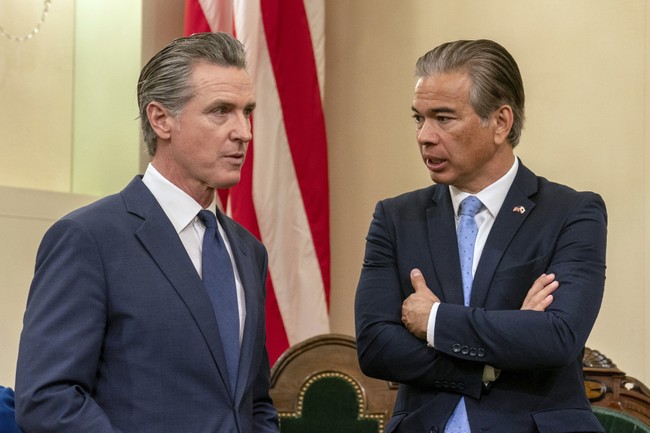
This piece reviews recent developments around California Attorney General Rob Bonta’s ties to a federal bribery probe, the Duong family’s alleged scheme with former Oakland Mayor Sheng Thao, and the revelation that Bonta’s campaign paid $468,228 to outside counsel during the investigation.
California politics has been in flux since indictments connected to the Newsom administration surfaced, but a different thread has quietly grown louder: allegations involving Sheng Thao and business partners David and Andy Duong. The Duongs are accused of arranging payments and no-show jobs in exchange for municipal contracts tied to homeless housing projects. Those allegations, filed in January 2025, triggered scrutiny well beyond Oakland city halls and into Sacramento circles.
The Duong family has a history that includes federal scrutiny for alleged straw contributions and a reputation for leveraging relationships with state officials to secure contracts. That reputation helped fuel questions after the latest indictments, because people noticed how often the Duongs appeared in the social orbit of state leaders. Observers wondered if political giving crossed into pay-to-play behavior when city contracts were involved.
Rob Bonta’s campaign returned about $155,000 in donations from the Duongs after the federal probe became public in 2024, and his office has insisted he and his wife, Assemblymember Mia Bonta, did nothing improper and were unaware of any deal between Thao and the Duongs. Still, new reporting revealed an eyebrow-raising campaign expense: “made five separate payments to the law firm Wilson, Sonsini, Goodrich & Rosati totaling $468,228” for “professional services (legal, accounting).” That figure landed like a splash in an already muddy pond.
Campaign spokespeople first framed the payments as part of supporting broader law enforcement work related to the East Bay prosecutions. The initial spin was that the Attorney General was simply aiding federal partners, using outside counsel to ensure those responsible for alleged bribery were held accountable. That explanation left critics asking why campaign funds, not department resources, were used for that purpose.
As scrutiny mounted, Bonta’s team pivoted to a different explanation: the funds went to lawyers defending Bonta while he answered federal investigators’ questions. Dan Newman told reporters that the money was used to hire attorneys for Bonta’s own responses during an 18-month FBI inquiry and that Bonta “is not and was never a target of the investigation.” The campaign insisted the expenditures were “absolutely proper” and not tied to Mia Bonta’s legal needs.
KCRA’s reporting forced the campaign to clarify that the campaign paid for counsel, not the Department of Justice. That raises a hard question for voters who expect the Attorney General to maintain clear separations between official duties and campaign finance. If campaign coffers cover legal costs tied to an FBI inquiry, the line between public office and political machinery looks dangerously blurry.
“There are of course ongoing legal proceedings in the East Bay in which several people were charged with serious crimes. The AG wants to ensure that anyone who committed a crime is held accountable, so he engaged outside legal counsel to help his law enforcement partners pursue justice.”
Campaign finance experts say the Fair Political Practices Commission won’t weigh in unless a complaint lands on its desk, so the legality of the payments remains untested unless someone files. That procedural reality means political pressure and public opinion may do more than legal rules in the near term. Republicans and watchdogs have already signaled they’ll watch for inconsistencies and potential misuse of campaign funds.
Critics point to two plausible reasons for the payments: legal representation for Bonta and his spouse during the FBI inquiry, or financial help for those close to the Duongs and Thao. Only one of those uses would likely be allowed under campaign finance rules, depending on the precise questions posed by investigators. Without transparent documentation and a formal review, that ambiguity fuels suspicion.
Another wrinkle: sources told reporters Bonta is weighing whether to run for governor, and that political operatives are quietly testing the waters for a statewide bid. Speculation about ambition makes the optics worse, because voters don’t respond kindly when candidates appear to use campaign funds for personal legal protection while contemplating higher office. If a gubernatorial campaign is imminent, opponents will press these expenditures into the spotlight.
“KCRA 3 followed up on Tuesday, pressing the campaign on whether that was a permissible use of campaign funds and specifics around the legal expenses. Dan Newman, Bonta’s reelection campaign adviser, then confirmed Bonta used the money to hire attorneys to help him as he answered questions from federal investigators.
Newman said Bonta is not and was never a target of the investigation and said the use of funds was “absolutely proper.” He said it was necessary to use campaign funds “because of the nature of the charges against the people implicated.”
Newman confirmed the money was not used to help his wife, Assemblymember Mia Bonta. He also stated Bonta’s involvement in the investigation is over.
For conservatives and accountability-minded voters, the situation reads like a case study in why transparency matters, especially when public servants face overlapping legal and political pressures. The basic questions remain straightforward: Were campaign dollars used appropriately, and will a formal complaint force a public review? Until those questions are answered, Bonta’s political future will be shadowed by doubt.

Both Bonta and Newsom should face a firing squad at GITMO!