
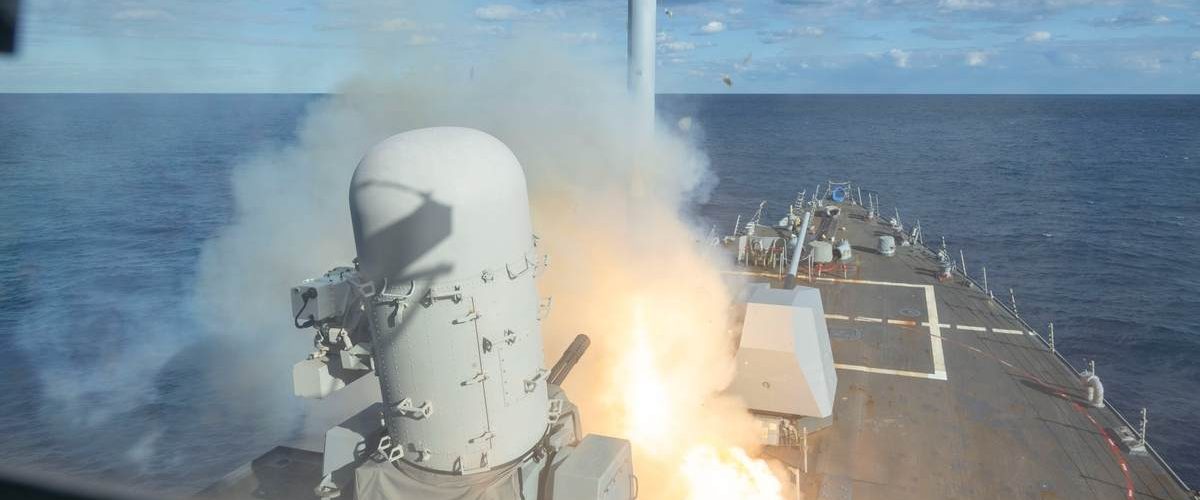
The United States carried out a limited military strike against Iranian forces after observing rocket launchers arming sea mines near the Strait of Hormuz, an action that marked the first acknowledged U.S. strike on Iran in a month and drew a vow of retaliation from Iran’s Revolutionary Guards.
U.S. Central Command reported that American forces struck two rocket launchers that were preparing to disperse mines into the Strait of Hormuz, a strategic corridor for global oil and gas shipments. The move came after intelligence and surveillance detected preparations on Larak Island that threatened commercial and military shipping in the area. U.S. commanders have been monitoring the waterway closely, with naval vessels, Air Force jets, and Army helicopters on alert to protect transit. This limited attack appears to be measured rather than an escalation into broad bombing operations.
The attack was the first by the United States against Iran in a month and appeared to be limited rather than a resumption of large-scale American bombing.
This strike was the first the Pentagon has acknowledged against Iran since Central Command stuck dozens of targets inside Iran on July 29, including command centers, missile and drone facilities and coastal surveillance sites.
Capt. Tim Hawkins, a Central Command spokesman, said Iranian Islamic Revolutionary Guards Corps forces were observed preparing rockets armed with mines for launch from Larak Island into the surrounding strait. Clearing previously planted mines, U.S. forces have been working to keep the shipping lane safe; Adm. Brad Cooper reported mine-removal activity last week. Given the vital nature of the Strait of Hormuz, preventing any disruption to commercial shipping is a top military priority. Commanders framed the strike as narrowly tailored to stop an imminent threat.
Capt. Tim Hawkins, a spokesman for Central Command, said that Iran’s Islamic Revolutionary Guards Corps forces had been observed preparing to launch rockets armed with mines from Larak Island into the waters of the surrounding strait, a vital shipping waterway for oil and gas.
As of last week, U.S. forces had cleared the mines that Iran had planted in the strait, according to Adm. Brad Cooper, the head of Central Command.
This action followed a weeks-long campaign that blended military responses and sanctions aimed at degrading Iran’s ability to wage asymmetric attacks on shipping. Operations named Operation Economic Fury and Operation Economic Outcast signaled a dual approach: kinetic responses to immediate threats alongside financial measures to choke off resources and shadow networks. Iranian leaders had hinted at renewed peace talks while facing increasing pressure from both sanctions and strikes. Still, rhetoric and reality diverge, and Tehran has publicly vowed to retaliate for the strike.
The Revolutionary Guards’ statement said the attack “will be responded to with punishment on the aggressor,” and Iran’s Tasnim news agency reported two fatalities, a claim that could not be independently verified at the time. The Pentagon had not issued an immediate public comment addressing casualty claims. Such claims often surface in early reports during fast-moving incidents, and U.S. officials usually withhold casualty estimates until assessments are complete. The risk of miscalculation remains high when both sides trade strikes and statements.
The Revolutionary Guards said the attack “will be responded to with punishment on the aggressor,” according to Iran’s state broadcaster. The Iranian news agency Tasnim said that two people had been killed in the strike, a claim that could not be immediately confirmed. The Pentagon did not immediately respond to requests for comment.
https://x.com/CENTCOM/status/2094172416750567778
Operational commanders continue to emphasize deterrence and freedom of navigation patrols in the region, noting that U.S. forces remain postured to defend vessels passing through the strait. The corresponding combination of forward military presence and targeted strikes aims to raise the cost for Iran to interfere with international shipping. That posture has been reinforced in recent months with high-visibility naval deployments and aerial reconnaissance. Officials say that clear, calibrated responses can blunt larger confrontations while protecting critical commerce.
Editor’s Note: Thanks to President Trump and his administration’s bold leadership, we are once again respected on the world stage, and our enemies are being put on notice.
Regional tensions are likely to remain elevated as Iranian forces assess options for retaliation and U.S. forces retain an active deterrent presence. Intelligence, surveillance, and reconnaissance assets will continue to track activity around island launch sites and shipping lanes to detect any repeat attempts to seed mines. Policymakers will face the choice of responding proportionately to future provocations while avoiding escalation that could drag multiple countries into a broader conflict. For now, commanders describe the strike as a focused measure to prevent an immediate maritime threat and to uphold the principle that attacks on commercial traffic will not go unanswered.



Add comment