
A new report says China may be supplying Iran with hundreds of shoulder-fired air defense launchers, prompting strong warnings from President Trump about consequences; Beijing denies the claims, Tehran would use mobile air defenses that are hard to neutralize, and U.S. and Gulf partners are watching closely as tensions rise in the region.
Multiple sources told a major news outlet that China was considering sending as many as 400 Chinese-made man-portable air defense systems, including QW-12 and FN-16 missiles, to Iran. Those kinds of weapons are small, quick to deploy, and highly mobile, which makes them a dangerous addition to an already tense battlefield. The report named an intermediary company said to be involved in arranging the transfers, a detail that raises questions about how this would be routed around international scrutiny.
Beijing reacted with a flat denial, saying, “The relevant reports are completely groundless. China has consistently played a role in promoting peace and ending the conflict.” That statement is noted here exactly as released, but observers familiar with state messaging point out that denials are standard when a country faces scrutiny for covert military transfers. From a Republican perspective, such denials demand hard evidence and firm follow-through rather than relying on assurances.
The United States has been striking Iran’s missile and drone infrastructure to blunt the regime’s ability to project force, and Iran has been heavily resupplying and rearming after substantial losses. That depletion, combined with ongoing pressure from U.S. and allied forces, creates the motive for Tehran to seek new sources of air-defense capability. If true, a major arms shipment from China would represent a geopolitical escalation that touches U.S. security interests and the stability of the Gulf.
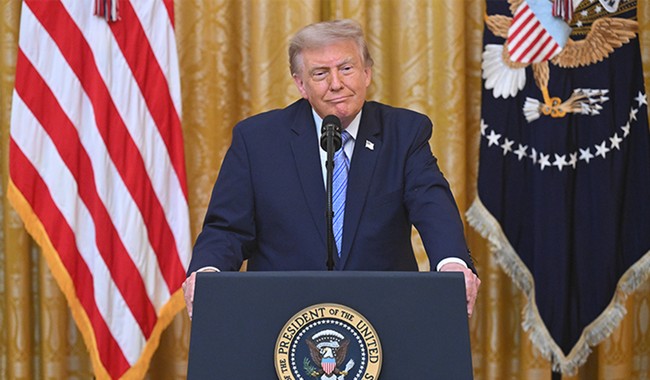
When President Trump was asked about the report during a press briefing, he responded directly, and the exchange was followed by an on-camera statement that carried a warning tone. Trump replied, “That would be surprising…he told me very strongly he wouldn’t partake.” The exact wording above reflects the president’s comment, which signals skepticism but also provides the basis for a clear message to Beijing.
Trump then made his stance unmistakable: “But he knows I’d be quite disappointed,” Trump said with emphasis. “And he’s coming here, I think, on September 24th.” Those words were delivered plainly and were meant to convey that actions have consequences, especially when they impact American forces and regional partners. From a Republican angle, such firmness is necessary to deter adversaries and protect U.S. interests without endless equivocation.
A supply of hundreds of MANPADS to Iran would complicate operations across the region, because shoulder-fired systems can be moved rapidly and concealed, making them tough to find and destroy. The mobility of these systems turns even routine air operations into risky business, threatening not only military aircraft but also civilian flights in contested skies. That is why U.S. planners and Gulf allies would view any such shipment as unacceptable and potentially provocative.
Options for a U.S. response range widely, from targeted sanctions and tariffs to diplomatic isolation and covert measures, but each carries risks and trade-offs. Republicans typically favor decisive pressure that imposes a clear cost on state actors who enable Tehran’s military expansion. If China were to assist Iran in a way that materially strengthens its ability to strike or defend, the U.S. would be expected to respond in ways that protect American forces and deter further transfers.
https://x.com/FoxNews/status/2082559044594680290
The alleged transfer would also risk souring Beijing’s ties with Gulf states that have been cooperating with the U.S. to counter Iranian aggression. Saudia Arabia and other neighbors have a direct interest in preventing an arms buildup that could destabilize maritime routes and border areas. Aligning with Tehran on sophisticated portable air defenses would therefore not only inflame U.S.-China tensions but could fracture relationships in a region that needs stability.
Previous Iranian attacks and attempted strikes have prompted robust retaliatory actions, and U.S. leaders have signaled a readiness to escalate pressure on Tehran when American forces are targeted. Recent operations by U.S. and regional partners against Iran-backed militias underline a posture of firm response. In that context, any external effort to equip Iran with mobile air defenses would be met with serious consideration of all tools available to Washington.
Public denials by Beijing will do little to reassure skeptics unless they are matched with transparent actions that can be verified by independent observers. For those watching from a Republican viewpoint, words must be backed by clear behavior changes or consequences. The stakes are high: shipments of advanced, portable air defenses would reshape tactical dynamics and demand a strong policy answer to prevent further escalation in the Gulf region.
China’s Foreign Ministry said: “The relevant reports are completely groundless. China has consistently played a role in promoting peace and ending the conflict.”

Add comment