
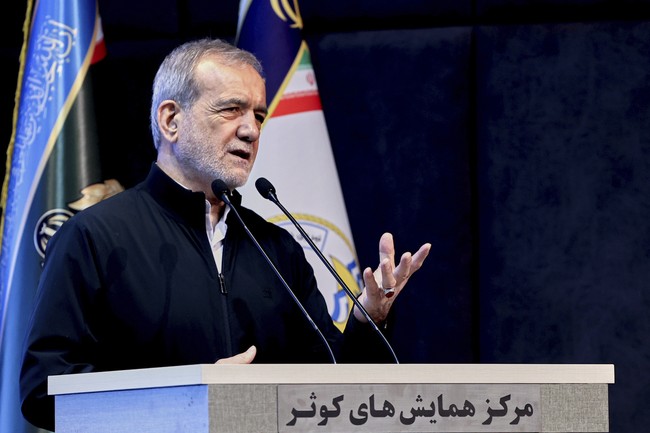
I’ll cut to the chase: this piece examines Iranian President Masoud Pezeshkian’s public letter to Americans, weighs its claims against recent events, highlights contradictions in his statements, and assesses what motives might drive such an appeal.
Leading Iran right now is a political tightrope where external threats and internal factions collide, and Pezeshkian’s letter lands squarely in that tension. He releases a public message that sounds conciliatory, but the context includes recent attacks, proxy violence, and a history of hostile rhetoric toward the United States. That background makes every claim in the letter worth scrutinizing instead of taking at face value.
Now Pezeshkian has issued a “letter to the American people.” Hello, festival of political gaslighting and trying to manipulate the American people.
The letter contains sweeping statements about Iran’s historical behavior and intentions, presented as if past wrongs and current hostile actions do not exist. Pezeshkian writes claims about Iran never choosing aggression or domination in modern history, framing the nation as peaceful despite repeated conflicts and proxy attacks. That assertion conflicts with the record of Iranian-supported militias and documented plots that have harmed Americans and allies.
Iran has never, in its modern history, chosen the path of aggression, expansion, colonialism, or domination. Even after enduring occupation, invasion, and sustained pressure from global powers—and despite possessing military superiority over many of its neighbors—Iran has never initiated a war…The Iranian people harbor no enmity toward other nations, including the people of America, Europe, or neighboring countries…For this reason, portraying Iran as a threat is neither consistent with historical reality nor with present-day observable facts.
That quote, printed exactly as he issued it, reads like a defense brief rather than an evenhanded diplomatic outreach. It asks readers to set aside concrete incidents: hostage takings, attacks by proxies, open threats, and chants that have often targeted America. For an American audience, these incidents matter when deciding how to respond to Tehran’s overtures, so the letter’s omissions feel deliberate.
Pezeshkian’s rhetoric is also at odds with prior statements he made in late 2025 that openly described conflict with Western powers. He previously said, “In my opinion, we are in a full-fledged war with America, Israel, and Europe,” framing Tehran as a party already engaged in hostilities. That earlier language undercuts the current attempt to present Iran as a misunderstood, peaceful nation.
He complains about sanctions and references historical grievances like external backing for the Shah, yet the letter skirts the reality that decades of support for proxies and acts of violence have consequences. Sanctions are a response to a pattern of behavior, not an arbitrary punishment, and selective historical framing does not neutralize that pattern. Calling out one historical chapter while ignoring others makes the letter read more like a bargaining stance than a genuine olive branch.
On the home front, Pezeshkian talks up concern for ordinary Iranians suffering from military action. That claim rings hollow to many who point to Tehran’s harsh treatment of dissenters and the violent crackdowns on domestic protests. If the regime truly prioritized its people, critics argue, it would not have tolerated years of repression that drove citizens to flee and resist.
There is another layer here: internal politics and personal survival. The Iranian political system is factionalized and often ruthless, and public appeals can be shields as much as policy statements. Given the Revolutionary Guard Corps’ influence and history of purging rivals, an image campaign aimed at Western audiences can also serve to placate or reposition domestic power brokers.
Pezeshkian briefly flirts with arguments blaming external actors for exaggerating threats, even suggesting others manufactured the idea that Iran is dangerous. For many Americans, however, evidence of Iranian-backed attacks, support for terrorism, and involvement in significant regional violence are not fabrications. Efforts to sow doubt about those facts are predictable when a government seeks to erode support for deeper foreign involvement against it.
His appeal to Americans to listen to visitors and travelers who saw Iran is an odd choice given the number of refugees and exiles who have fled Tehran and testified about repression. Those voices speak loudly about the regime’s nature, and many would welcome a change in leadership rather than a reputational rehabilitation. Asking Americans to weigh selective experiences against a long record feels like an attempt to reframe the narrative.
At its core, the letter reads less like a frank diplomatic starting point and more like a defensive maneuver. Whether the goal is to blunt calls for stronger action, to curry favor with isolationist currents in American politics, or to secure personal protection from hardline factions back home, the result is political theater. For readers judging the message, context and past conduct remain the most reliable guides to intent and credibility.


Add comment