

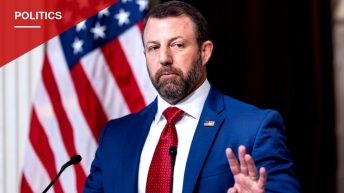
Department of Homeland Security Secretary Markwayne Mullin says artificial intelligence may be responsible for the wave of technology outages that have hit airlines and banks in recent days, including an incident that grounded all US flights for hours last week.
Mullin raised the theory on Monday after United Airlines and several major banks reported widespread system failures, coming on the heels of last week’s disruption that knocked out Microsoft systems and the entire US airline network.
Speaking to Fox News, the DHS chief said he had talked with someone in the tech industry — not Tesla CEO Elon Musk, he clarified — who suggested the outages stem from new AI systems running on older infrastructure that wasn’t built to handle them.
“He said, ‘I believe it’s SI, because these programs aren’t designed to work as fast as SI is,'” Mullin said, using President Trump’s preferred term “SI,” or “super intelligence,” for the technology.
Mullin laid out the explanation he was given in more detail.
“So when they put in a program that’s able to write code, it goes in and self-fixes itself, as it starts to self-fix itself, like a change order on a house. When you change one thing in a house, everything else starts changing as a ripple effect,” he said.
“It causes the systems to be overrun that weren’t designed to run as fast as the SI technology is today. That was the conversation I had today. That kind of makes sense to me,” Mullin said.
The secretary said he is “98%” confident the outages are not the result of a coordinated cyberattack on the United States, pointing out that no group has claimed responsibility for the disruptions.
“They’re all individually unrelated,” he said of the separate incidents.
Mullin said he believes the failures originated internally rather than from outside attackers, since investigators found no digital footprint of activity moving in or out of the affected systems.
Experts see a pattern, and warn of more trouble ahead
Industry experts told The Post that the timing of these outages is unlikely to be coincidence — and that the situation could worsen before it improves.
Companies that run core parts of the digital economy are racing to install new AI tools into complex, often aging computer systems just as the holiday season approaches, when both consumer spending and employee absences spike.
“It’s holiday time, it’s travel time, it’s shopping. So you have all those higher spikes in volume, and more pressure to [update your systems,]” said Marva Bailer, CEO of tech advisory firm Qualaix.
Bailer said legacy systems have been patched together with components from AI companies and third-party vendors, creating more potential points of failure as firms try to keep pace with new technology.
Add comment