
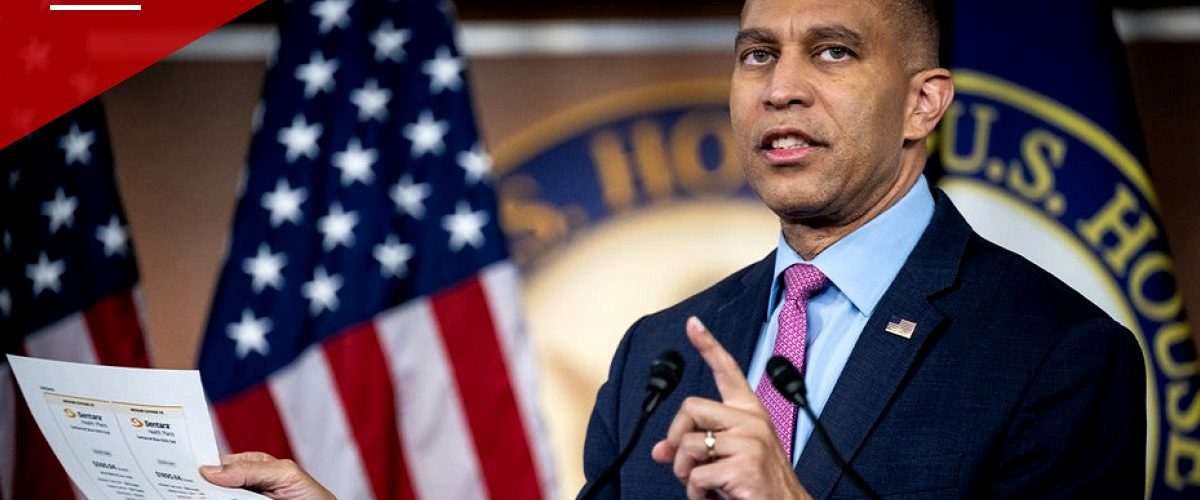
House and Senate Democrats head into leadership votes this week with no consensus on who should run the party, despite the fact that neither Hakeem Jeffries nor Chuck Schumer faces a declared rival for their current posts.
In the House, Rep.-elect Angela Gonzales-Torres, D-Calif., said she currently opposes elevating Jeffries, D-N.Y., to Speaker. “As of today, my position is no because that’s what my constituents and my community is saying,” she said. “It’s really about the process. We want a democratic process. And that’s what we’re really fighting for. It’s not about one person.”
No one has entered a race against Jeffries, which has led some of his supporters to argue the House Democratic caucus should simply confirm him by acclimation on Wednesday. Rep.-elect Jessica Killin, D-Colo., who flipped a district from red to blue, backs that approach. “He hasn’t had the opportunity to work in the majority as a leader of our party yet and I want to give him that opportunity,” she said.
Other Colorado Democrats aren’t there yet. Progressive Rep.-elect Melat Kiros, D-Colo., said “Not yet” when asked if she’d vote for Jeffries, adding, “Ultimately this is about making sure that there is a democratic process in lieu of there not being multiple candidates.”
Skepticism also comes from the center of the caucus. Rep.-elect Sam Forstag, D-Mont., who won a western Montana district that President Trump carried by 11 points two years ago, said he has not committed his vote. “I’ll be voting for whoever’s going to actually help us modernize the way this place works,” he said.
Killin, a former House Democratic chief of staff before her election, said the hesitation reflects the sheer size of the incoming class. “We have a wild and unwieldy freshman class. It’s over 100 people. This is part of process,” she said. “Each person needs to follow their own process on how we’re electing leadership.”
House Republicans, by contrast, settled their own leadership question last week, choosing Rep. Jim Jordan, R-Ohio, as Minority Leader over current Majority Leader Steve Scalise, R-La. Rep.-elect Chris Stigall, R-Mo., predicted a messier process for Democrats. “They’re going to have one heck of a fight on their hands deciding who the voice of their party going forward is going to be,” he said. “If Team Jeffries can somehow manage to wrangle and herd those cats, it’ll be a miracle, frankly.”
Van Hollen Challenges Schumer in the Senate
In the Senate, Sen. Chris Van Hollen, D-Md., is mounting a direct challenge to Senate Minority Leader Chuck Schumer, D-N.Y., for the top Democratic post. Van Hollen pointed to midterm wins in states that had not gone Democratic in years as justification for his bid. “We understand that this will be a competition,” he said. “I think it’s important to give Senate Democrats a choice. That’s what we just gave voters all over the country. A choice. They chose change.”
Schumer, who turns 76 next week, has led Senate Democrats for a decade; Van Hollen is nearly nine years younger. According to the report, at least five senators or senators-elect who caucus with Democrats back Van Hollen, while three Democratic-caucusing senators have said they won’t support Schumer. Sen. Elissa Slotkin, D-Mich., is among them: “I’ve been open that I’m not voting for Sen. Schumer,” she said.
Schumer still has defenders. Sen. Kirsten Gillibrand, D-N.Y., praised his effort this cycle. “This caucus is grateful for the hard work of Sen. Schumer. No one has put in the time and effort that anyone has put into this cycle than he did,” she said. “That is why you will see, despite all the grumblings, enormous gratitude for the hard work he has done to get us to this position.” Sen. Richard Blumenthal, D-Conn., said: “Chris Van Hollen is a great colleague. But I’m supporting Chuck Schumer.”
Even New York City Mayor Zohran Mamdani, a Democrat, declined to endorse his home-state senator directly. “I care less about who it is and I care more about what they do with that power,” Mamdani said. Sen. Ruben Gallego, D-Ariz., who is aligned with Schumer, struck a similar note: “I think no matter who is Leader, we’re going to deliver on this agenda.”
Protests and Policy Fault Lines
The tension isn’t confined to leadership votes. A small group of demonstrators confronted Jeffries at a Democratic conference in Colorado late last week, shouting about impeachment and calling him a vulgar name, according to the report.
Republican Sen. Dave McCormick, R-Pa., framed the unrest as a defining moment for the party: “There’s really a fight for the soul of the Democratic Party. Are they going to embrace these radical ideas?”
Some incoming progressives reject the idea of a divided party. “People try to say we’re fractured as a party. In reality, we’re all working on the same message,” said Rep.-elect Donavan McKinney, D-Mich. Rep.-elect Fred Wellman, D-Mo., who defeated Rep. Ann Wagner in a historically red district, called the infighting healthy. “I think a little bit of scrumming around inside the party is a good thing. The wonderful thing about my party is we’re more than happy to duke it out,” he said.
Rep.-elect Eric Jones, D-Calif., pushed back on that framing. “I wouldn’t go so far as to say ‘duke it out’ because those are fighting words,” he said. “But there are definitely open conversations. They’re pretty collegial. Pretty collaborative.”
Policy disagreements underline the leadership fight. Sen. John Fetterman, D-Pa., said he opposes what he called Van Hollen’s “strong, anti-Israel kinds of views,” adding: “I can’t really think of what Van Hollen is known for. But he became like a progressive darling. But I don’t see that he has a path to be leader.”
Van Hollen’s backers point to his support for D.C. statehood and willingness to revisit the filibuster. D.C.’s new non-voting House delegate, Del.-elect Robert White, D-D.C., said, “Sen. Van Hollen has been a long-time supporter of DC and DC statehood. I would get rid of the filibuster in order to get DC statehood.” Van Hollen himself said he would not end the filibuster “right out of the gate,” though he called it an “undemocratic provision.”
Those specifics — on the filibuster, D.C. statehood, and proposals like Medicare for All — are likely to shape which Democrats ultimately back which leader, as moderates who flipped Republican-leaning districts weigh priorities against a more progressive wing of the incoming class.



Add comment