
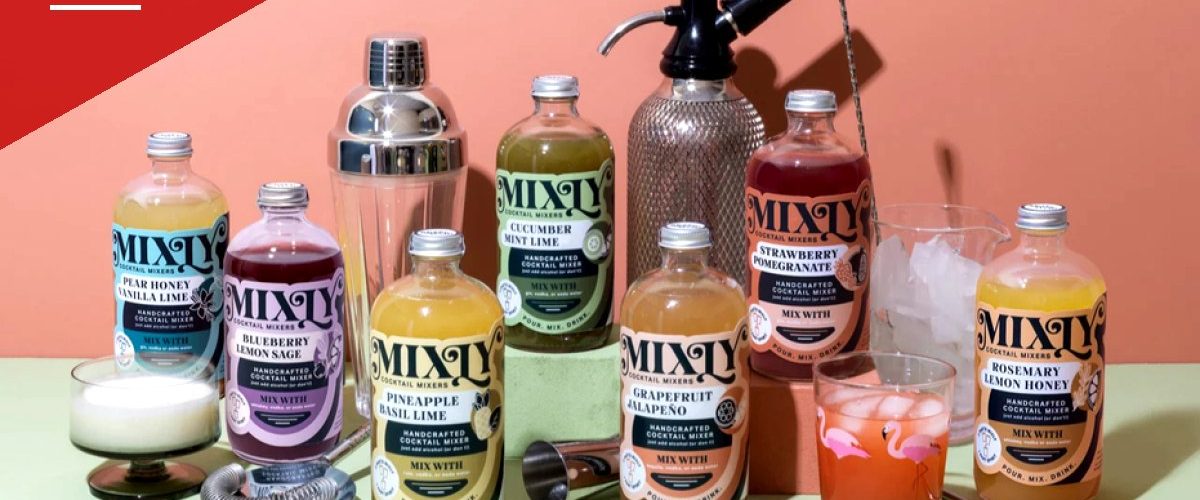
Johnna Rossbach spent 15 years in a career she says left little room for creativity before she decided, after becoming a mother, to build something of her own. The result is Mixly, a line of fruit-forward cocktail mixers that she co-founded with Megan Sather, and the company has grown entirely without outside equity investors.
“I wanted to show my daughters what it looks like to be empowered, and that if you’re not happy with something, change it,” Rossbach said.
Rossbach had grown frustrated with store-bought mixers, which she found repetitive in flavor, heavy on ingredients she wanted to avoid, and often too labor-intensive to use. Drawing on her marketing background and pairing with Sather’s design skills, she set out to build an alternative.
The company’s first working night became a kind of origin story. The pair started at 4 p.m. and didn’t stop until 3 a.m. Their juicer broke, so they squeezed limes by hand. Their labeler failed, so they applied every label themselves. Around midnight, with hours of work still ahead, they chose to push through rather than quit for the night.
“That was the moment we realized we made the best business partners,” Rossbach said. “We had the same determination and the same willingness to roll up our sleeves and figure things out, even when nothing was going according to plan.”
That night set a pattern the founders have kept: they still handle their own manufacturing. After developing recipes with a mixologist friend, the company hit the disruption of COVID-19, which forced Rossbach and Sather to work out production methods on the fly while making the products themselves in a rented kitchen.
“When you start a business, there is no map,” Rossbach said, describing the hardest part of the process as the constant decisions, self-doubt and risk of getting things wrong.
Mixly has been self-funded since its founding, a deliberate choice the founders made to retain control of the company. Rossbach says that structure raises the personal stakes of every decision.
“We’ve put our own money, time and countless hours of work into Mixly,” she said.
Built for everyone, not just drinkers
Rossbach was pregnant as the company took shape, around the time the sober-curious movement began gaining traction. She and Sather wanted a product that worked whether or not someone was drinking, so no one at a gathering felt excluded.
“Let’s make this versatile. Let’s make this for everyone,” Rossbach recalled thinking.
Mixly’s mixers have been alcohol-free from day one — the positioning isn’t a reaction to a trend, Rossbach said, even as public interest in alcohol-free drinks has grown.
“I think the interest in drinking less extends well beyond January or October,” Rossbach said. “People want a good option for an ordinary Tuesday, dinner with friends or a celebration.”
The mixers are built to work with or without a spirit, relying on fruit, acidity, herbs and bitter botanicals rather than straight sweetness. The company’s Bitter Orange Cherry mixer uses gentian root to add complexity.
“A good alcohol-free drink does not need to apologize for what is missing,” Rossbach said. “It doesn’t have to imitate a cocktail to deliver that.”
Customers found new uses
Customers began using the mixers in ways the founders hadn’t planned for — one added a mixer to her kids’ water, others used the products in cooking and marinades. Rossbach’s own daughters became fans of a local dirty soda shop, spending roughly $20 on two drinks, which led Rossbach to adapt Mixly’s flavors for dirty sodas. Her daughters now make the drinks at home and run a neighborhood stand.
In June 2026, the company renamed itself from Mixly Cocktail Co. to Mixly Beverage Co. to reflect that broader range of uses, including dirty soda and coffee applications.
The expansion has moved Mixly into major retail chains. Five flavored syrups launched in 685 Walmart stores, and the company expects its dirty soda products to reach nearly 4,000 stores by the end of November. Two holiday kits launched in 1,300 Target stores and online. Mixly says its products are now sold in approximately 4,600 retail locations nationwide.
Rossbach said the growth traces back to the founders’ original idea: a flavorful product anyone can share, drinking or not. Getting there required rethinking an early, ultra-premium product line after learning that what she assumed customers wanted wasn’t always accurate — and staying willing to adjust as the business grew well beyond the rented kitchen where it started.

Add comment