
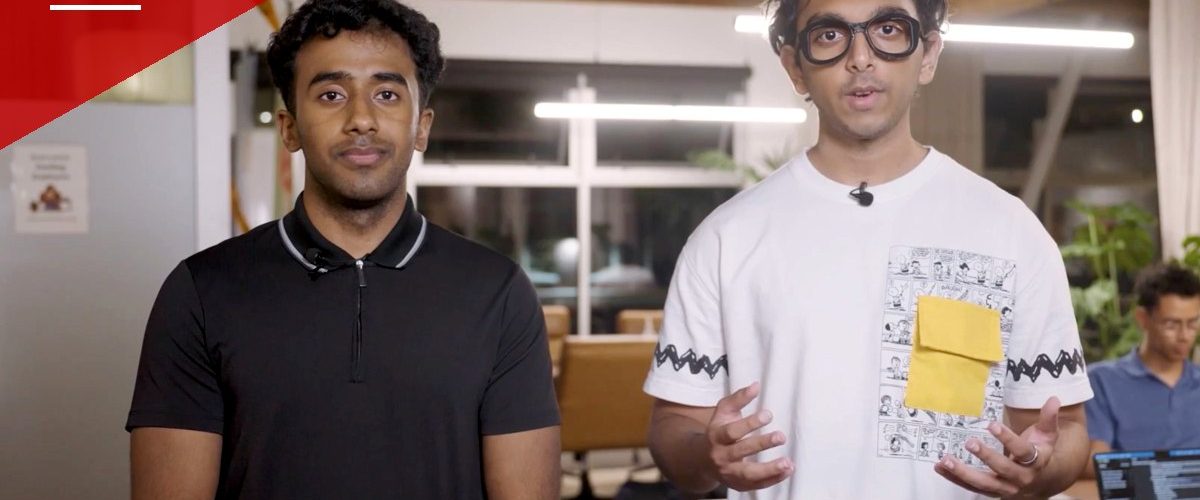
A San Francisco startup called Subvocal has launched AI-powered glasses that can convert silently mouthed words into text, raising fresh questions about how much physiological data people will be asked to hand over for workplace convenience.
The glasses, unveiled last week, use low-power radio waves similar in frequency to Bluetooth to detect the tiny facial and mouth muscle movements people make when they mouth words without speaking aloud. An onboard AI decodes those signal changes into text at a claimed rate of 200 words per minute.
“When you’re mouthing words, even if you’re really discreet with it, the muscles in your face and inside your mouth are moving right,” said Aarush Yadav, who co-founded Subvocal in February 2026 with Georgia Tech student Arnav Kumar. “So what the glasses do is they emit radio waves similar to Bluetooth, similar frequency, but much lower power.”
Yadav built the prototype for Stanford’s Treehacks Hackathon in February. He and Kumar have since raised $1.3 million and left school to work on the company full time. A demo video showing two wearers communicating silently across a room has drawn nearly 12 million views on X.
“There are no limitations,” Yadav said of the technology’s potential uses, which he said include replacing keyboard typing and voice-to-text software in settings where speaking aloud is impractical — offices, libraries, trains, and for people who run multiple AI agents requiring long typed prompts.
“Voiceover typing is obvious,” Yadav said. “It’s extremely fast and makes you so much more productive. But when out in public in the office or in the library, we couldn’t use voice AI. It’s just too awkward to talk into your computers and to other people as well.”
The glasses are available for preorder now, with delivery estimated for March 2027. The list price is $699, discounted by $200 for early orders.
Mixed public reaction
Reaction online has split between enthusiasm and skepticism. One popular X account, Science Girl, called the device “awesome,” writing: “We’ve gone from typing to talking to our computers, and now we’re moving to communicating without making a sound.” Another commenter who frequently uses voice-to-text dictation software on planes called the concept “insanely cool.”
Others were less convinced the glasses solve the social-awkwardness problem they’re meant to fix. “Wearing the glasses and mouthing words to yourself seems maybe more embarrassing than just talking,” one critic wrote. Another joked, “Mumble rap is back and is weaponized.”
Scientists flag open questions
Dr. Rafael Yuste, a neuroscientist who directs Columbia University’s NeuroTechnology Center, told the Post he was both intrigued and cautious. “I am intrigued but cautious: it’s a clever engineering step for human-computer interaction, but Subvocal hasn’t published accuracy figures, so I’d call it promising rather than a breakthrough until independent data appear,” he said.
Yuste noted the device reads muscle activity rather than brain activity, but warned that any increase in the physiological data people generate carries privacy implications — particularly if that data is collected, stored or shared by companies or governments. He also raised concerns about what offloading verbal articulation to a machine might do to human cognition over time. “Writing and articulating words are part of how we organize and refine our thinking, and offloading all of that could weaken those processes in ways we don’t yet understand,” he said.
Yadav pushed back on the broader worry that the glasses deepen tech dependence, arguing they do the opposite by moving computing into the background rather than requiring a screen. “If you go to a park right now and you look at everyone around you, they’re going to be looking at a device,” he said. “The point of glasses is to pull you away from a device like your phone and put the computing in the background. So if you’re able to interact with them without touching a screen and without anyone hearing, you can use it anywhere you want and AI can do the work in the cloud for you while you can be present in the moment.”
Yadav said the current prototype’s accuracy and design are still being refined before the product ships. “We’re moving really fast on that,” he said.
No independent accuracy data for the device has yet been published, and Subvocal has not detailed what data the glasses collect, how long it is retained, or who has access to it once it leaves the device.

I discovered Freecash recently, and I really like the variety of activities available. You can choose from games, surveys, and other online offers to earn rewards.
I started here 👉 mub.me/maxreward