
A new biennial report from the Government Accountability Institute (GAI) identifies more than 50 documented vulnerabilities in U.S. election systems, released just before Election Day on November 3. The report, titled “Top 50 Election Threats,” groups its findings into five categories: noncitizen voting, ballot handling, partisan lawfare, political financing, and emerging technological and foreign threats.
“America’s elections face threats from every direction – foreign adversaries, political operatives, dark money, and government officials who refuse to enforce the rules,” GAI president Peter Schweizer said in a statement. “This report exposes more than fifty documented vulnerabilities.”
GAI vice president Eric Eggers, the organization’s lead voter fraud investigator, said the problems are not theoretical. “None of these threats are hypothetical – each one is documented, and most can be fixed if officials are willing to enforce the laws already on the books,” he said.
Noncitizen Voting
The report singles out noncitizen voting as an urgent concern. It cites an undercover investigation that found two Iranian nationals registered to vote in Michigan, and reports that roughly 6,600 self-identified noncitizens registered to vote in New Jersey between 2023 and 2024. A Census Bureau report linked more than 24,000 voters in the 2020 election to noncitizen status with high confidence, according to the GAI. The Department of Homeland Security has separately identified 278,000 noncitizens registered to vote in federal elections nationwide — a figure GAI describes as a conservative estimate built only from public records and data voluntarily supplied by ten states.
The report points to state policies it says make the problem worse, including Minnesota’s “vouching” system, which lets unidentified individuals cast ballots without showing ID, and California laws that shield noncitizens from prosecution if caught registering to vote. As of 2026, the report says, 22 local governments in the U.S. allow noncitizens to vote, while only 18 states have explicit state constitutional language barring the practice. Arkansas, Kansas, South Dakota, and West Virginia are voting November 3 on constitutional amendments that would restrict voting to citizens.
GAI also found that only 36 states require any form of identification to vote, and just 24 require photo ID. In Wisconsin, the report says, a loophole let nearly 150,000 voters registered as “indefinitely confined” receive absentee ballots in 2024 without a qualifying photo ID — a status claimed simply by checking a box, with no proof required.
Voter Rolls and Outside Groups
More than half of states decline free federal checks of their voter rolls, the report says, even as many of those same states share voter data with outside nonprofit groups such as ERIC and the Center for Election Innovation and Research (CEIR). Both organizations, GAI notes, trace back to David Becker, described in the report as a former PEW director of election initiatives and former director of the George Soros-funded People for the American Way. “The organization was supposed to be the fix for the inaccurate voter roll problem. Instead, states have accused ERIC of acting as a partisan operation to drive voter-registration at scale without verifying citizenship status,” the report states.
GAI calls on the Senate to take a standalone vote on the SAVE America Act, which would require proof of citizenship to register and photo ID to vote. The House has passed the bill multiple times, but it has stalled in the Senate. The organization also argues states should be required to cooperate with federal voter-roll audits.
“Granny Farming” and Ballot Harvesting
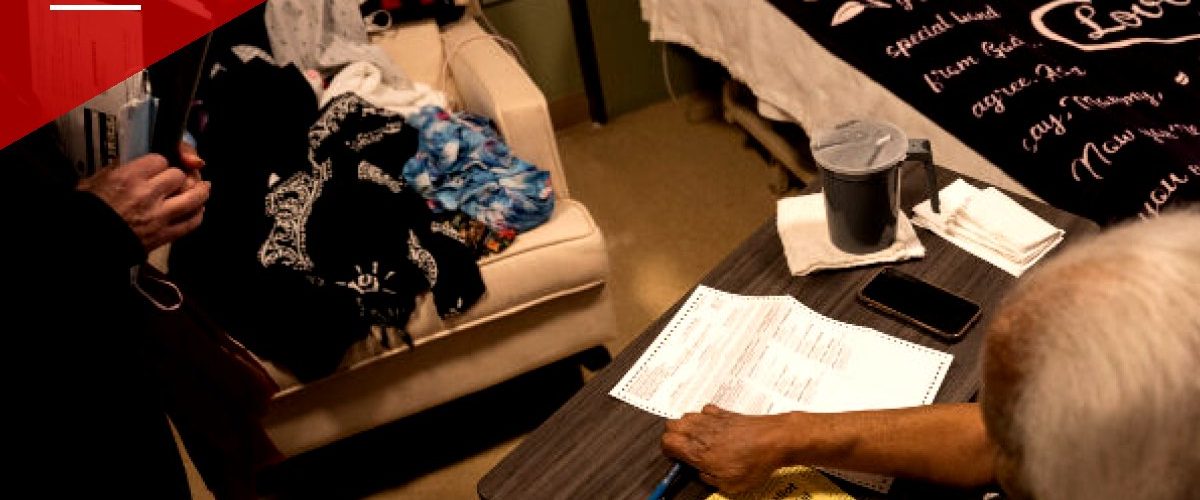
The report highlights a practice it calls “granny farming” — ballot harvesting targeting elderly residents of nursing homes and care centers, often without their knowledge. GAI cites a case in Macomb County, Michigan, where Trenae Myesha Rainey was sentenced to prison in 2022 for forging elderly residents’ signatures on absentee ballot applications at the nursing home where she worked. A similar case is noted in Texas.
Dark Money and Political Financing
The report also examines dark money flowing through nonprofit networks into election-related activity, including voter registration, turnout operations, ballot initiatives, litigation, and campaigns to change voting rules. GAI says its review of nonprofit filings through 2024 found major election organizations receiving tens and even hundreds of millions of dollars from overlapping donor networks, including Arabella, groups affiliated with George Soros, the Tides network, and Silicon Valley donors.
As an example, GAI points to America Votes, which sent “social pressure” mailers in Nevada during the 2022 elections claiming to track voter participation. The report says more than $300 million flowed to the group from two networks through 2024 — $252.4 million from Arabella-linked entities and $51.5 million from Soros-network nonprofits.
“Smurfing” and ActBlue
The report also details what it calls “smurfing” — breaking a large donation into many small ones under different names to dodge contribution limits and disclosure requirements, sometimes to launder illegal foreign money. The practice has drawn scrutiny through an investigation by 19 Republican attorneys general into ActBlue, an online fundraising platform supporting Democratic candidates.
According to the report, FEC records attribute more than 16,000 ActBlue donations totaling nearly $150,000 to an 88-year-old Michigan woman between 2020 and 2026, though she disputes ever donating anywhere close to that amount. Private investigators in Wisconsin found similar discrepancies, including an Appleton man disputing $93,168 across 7,878 donations and a Sister Bay playwright with nearly $20,000 attributed to his name despite saying he never made a political donation. A Republican strategist reportedly discovered small donations made to Bernie Sanders in his name, under the alias “Bernie Kane,” without his knowledge.
Researchers found further irregularities: a Fort Collins, Colorado, woman with 57,138 ActBlue contributions attributed to her across five name variations, totaling $234,441 over six years and two months; a Florida resident listed as making 52,591 contributions under 14 aliases over three years and one month, totaling $387,720.20; and a California resident credited with 52,501 contributions under nine aliases over nearly six years, totaling $884,152.
“These records raise questions on whether political funding platforms like ActBlue can reliably distinguish legitimate recurring donations from contributions made using another person’s identity, and whether they are taking adequate steps to prevent potential campaign finance fraud,” the report states.
Foreign and Technological Threats
The report also flags foreign interference, citing relationships between China and Mexico and U.S.-based get-out-the-vote groups, along with digital attacks on voting infrastructure and risks posed by emerging technology such as AI chatbots.
“The problem isn’t one bad actor or one broken election law,” said GAI’s executive director of research, Seamus Bruner. “It’s a system riddled with vulnerabilities that powerful interests can exploit. Our investigation identifies more than fifty threats – and shows exactly where the safeguards are failing.”



Add comment