
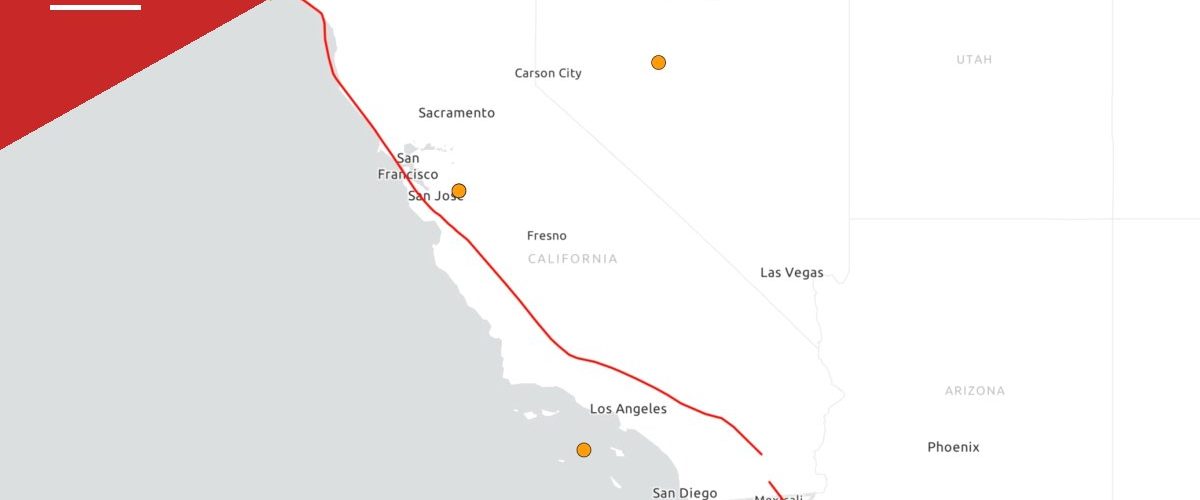
Three minor earthquakes struck along the San Andreas Fault in California over the weekend, each registering in the mid-magnitude 2 range, according to data from the U.S. Geological Survey’s Latest Earthquakes Interactive Map.
A 2.7 magnitude quake hit Petrolia at around 4:31 a.m. Sunday, followed roughly eight minutes later by a 2.6 magnitude shake near Santa Barbara at 4:39 a.m. The night before, Westley felt a 2.5 magnitude tremor. All three locations sit along the line the USGS map traces for the San Andreas Fault, one of the major tectonic boundaries running through the state.
None of the three quakes were strong enough to cause damage, but they arrive amid a string of research findings this year suggesting the fault system beneath California is under more strain, and moving more steadily, than scientists previously assumed.
New research points to steady slippage
In August, researchers at San Jose State University studied the landscape at Sanborn County Park for physical evidence of past earthquakes along the San Andreas Fault. Their conclusion: the fault appears to have been slipping at a faster and more consistent rate for nearly 10,000 years, rather than slowing down over time as some earlier models suggested.
A separate study released in June found that stress levels along three segments of the San Andreas and San Jacinto faults have reached their highest point in at least 1,000 years.
The last major earthquakes along the San Andreas Fault struck San Francisco in 1906 and Loma Prieta in 1989.
A fault ‘ready to rupture’
Ahmed Elbanna, director of the Statewide California Earthquake Center and a professor of earth sciences and engineering at the University of Southern California, told The Sacramento Bee that the June findings didn’t catch experts off guard.
“We have been lucky in California not to experience a large urban earthquake since 1994 on Northridge,” Elbanna said.
Elbanna said Southern California’s crust is “critically stressed and ready to rupture in a large-sized event,” but cautioned that no one can say when that might happen.
“Whether that event would happen tomorrow, or in 10 years, that’s the part that we don’t know,” he said.
For now, the weekend’s quakes serve as a reminder rather than a warning of anything imminent. The USGS continues to track activity along the fault in real time through its public interactive map.
Dear Conservatives who haven’t yet been chased out of California. Please get out before half of Cally disappears underwater. Every California citizen hopes that this disaster will never happen. HOPE is not a strategy! The scientific evidence consistently raises this eventuality and no one appears to be listening. Smoking is a bad decision, doing drugs is a bad decision, and waiting for a forecasted natural disaster is even worse.