
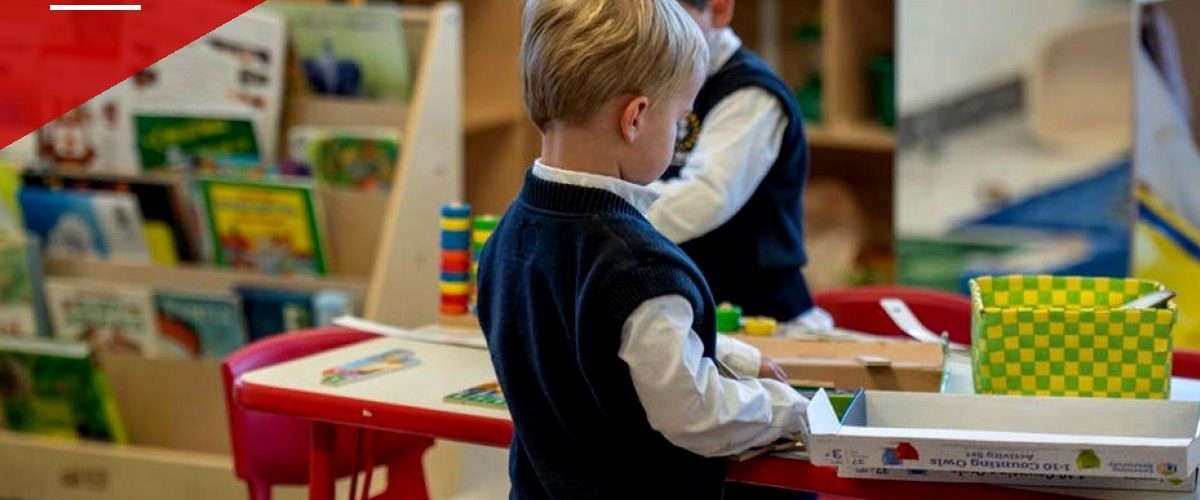
The Supreme Court will hear arguments Nov. 3 in St. Mary Catholic Parish v. Roy, a case brought by the Archdiocese of Denver, two parishes and several families challenging a rule that keeps Colorado’s Catholic preschools out of the state’s universal pre-K program.
Colorado’s program gives eligible 4-year-olds a benefit worth about $6,000 a year toward the preschool their parents choose. To participate, a school must agree to an “equal opportunity” provision that covers sexual orientation and gender identity. Catholic schools say they cannot sign that pledge without abandoning church teaching on marriage, sexuality and human identity, so they are excluded from the program entirely.
Dan and Lisa Sheley, parents of seven children who joined the Archdiocese and two parishes in the lawsuit, have five children already enrolled at St. Mary’s and say they have spent thousands of dollars out of pocket on a faith-based preschool education the state will not help fund.
Other families describe similar strain. One father pays for Catholic preschool out of pocket while his taxes support other families’ publicly funded preschool; one of his children has spina bifida, and the family says an extra $6,000 a year would meaningfully help with her care. A mother who works at a lumber company, married to a house painter whose work slows each winter, has six children with a seventh on the way. Another mother started a florist business to help cover tuition; three of her children attend a Catholic school in Denver, but she could not afford Catholic preschool for her youngest, who now attends a Lutheran preschool in the state program instead. A fourth parent took a lower-paying job at her children’s parish school for a tuition discount and says she has watched other families leave because of pre-K costs.
Andrea Picciotti-Bayer, who filed an amicus brief with the Supreme Court on behalf of the families, says enrollment in Colorado Catholic preschools has dropped roughly 20% since the rule took effect, that about 1,500 children across 30 schools have been shut out of the program, and that two preschools have closed.
Exceptions for some, not others
According to the brief, Colorado’s program allows providers to limit enrollment to specific groups — including children with disabilities, low-income children, children of color, gender-nonconforming children or members of the LGBTQ+ community — and state officials can grant further case-by-case exceptions. The brief argues no such flexibility has been extended to Catholic schools.
A legal history the case revives
The dispute echoes the 19th-century Blaine amendments, proposed after House Speaker James G. Blaine’s 1875 push for a constitutional amendment barring public money from “sectarian” schools at a time of widespread anti-Catholic sentiment. Blaine’s amendment passed the House but fell short in the Senate; roughly three dozen states nonetheless wrote similar provisions into their own constitutions. Justice Clarence Thomas noted in Mitchell v. Helms (2000) that “sectarian” was widely understood at the time as a stand-in for “Catholic.”
In Trinity Lutheran (2017), Espinoza (2020) and Carson (2022), the Supreme Court held that once a state creates a public benefit program, it cannot disqualify schools simply for being religious or for acting on their faith. The St. Mary’s case asks the court to apply that same reasoning to Colorado’s current preschool eligibility rules.
Colorado has also faced the Supreme Court in other disputes over religious liberty and free expression, including Masterpiece Cakeshop (2018) and 303 Creative (2023). The justices will now weigh whether the state’s preschool eligibility requirement can stand alongside those earlier rulings.


Add comment