
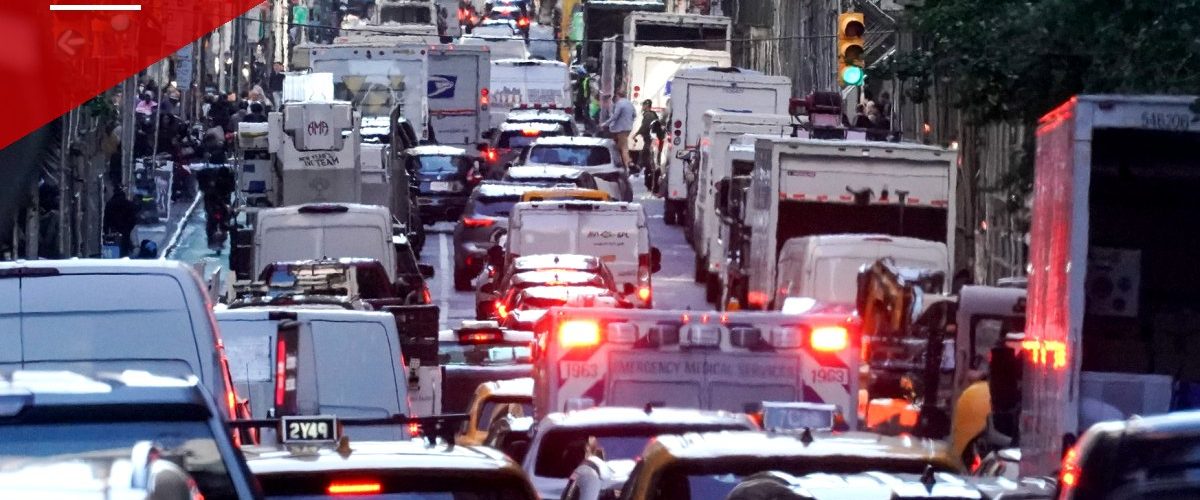
Nearly two years after New York City began charging drivers to enter Midtown Manhattan, commuters say the streets are as clogged as ever — they’re just paying thousands of dollars more a year for the privilege of sitting in traffic.
Truck-tracking data obtained from Geotab, a company whose software businesses install in commercial vehicles, found that speeds in the congestion pricing zone were largely unchanged between 2024 and 2025. Of the zone’s roadways, traffic moved faster along 37% of mileage, showed no significant change along 46%, and actually got slower along 16%.
That hasn’t stopped officials from declaring victory. Metropolitan Transportation Authority chief Janno Lieber has called the toll an “unqualified success,” claiming “all of the metrics” show drivers saving time. The agency has gone so far as to post signs on construction projects reading “made possible by congestion pricing.”
Drivers paying the bill see it differently.
“It’s just a money grab,” said Michael, 55, a courier from Queens filling up at a Mobil station at 36th Street and 10th Avenue. “Working people can’t afford it. I’m paying up to four grand, and I’m not getting any benefit. Traffic is not flowing.”
Benadon Benmore, 40, an ironworker from Harlem who works in Hell’s Kitchen, said his commute home hasn’t gotten any faster since the toll — championed by Gov. Kathy Hochul as a new revenue stream for the cash-strapped MTA — took effect.
“It still takes me two hours to get home,” Benmore said. “I’m gonna get me a real horse.”
Jhoffre Arevalo, 40, an Uber driver from Flushing, said he noticed a real improvement when the toll first launched, but the relief didn’t last.
“When congestion pricing started, you’d see the difference. Traffic went down a lot,” Arevalo said. “But now it comes back to normal. I think I see more traffic now.”
The Numbers Don’t Match the Claims
The MTA has claimed congestion pricing cut traffic entering the zone by 11% in 2025. But Port Authority vehicle counts at the Holland and Lincoln tunnels — two of the main routes into the zone — showed only a 4.5% drop in entries compared with 2024, before the toll began.
Geotab’s analysis, covering more than 50,000 commercial vehicle trips during the 8 a.m. to 6 p.m. window, found no meaningful speed improvement overall. Part of the problem may be built into how trucks are charged: cars pay once a day no matter how many times they enter the zone, but trucks are billed on every entry — which gives truckers an incentive to drive in once and park rather than make repeat trips.
That dynamic appears to be increasing idling. Geotab’s tracking, which registers a trip as ended when an engine shuts off or a vehicle sits still for more than 3.3 minutes, found commercial vehicles made about 4.6 stops a day in 2025, up from 4 in 2024 — and the company says those additional trips generated more emissions than the year before.
That complicates Hochul’s claim that the toll delivered “cleaner air.” A city Health Department report released in August found pollution levels inside the zone were not significantly different from what they would have been without congestion pricing.
The Toll Keeps Rising
Whatever the effect on traffic or air quality, the toll is generating serious money for the MTA: $548 million through September of this year, and more than $700 million across all of 2025, according to board documents.
For an individual commuter, the costs add up fast. A driver using E-ZPass who enters the zone at rush hour five days a week pays $45 a week — about $2,250 a year. A large truck making one trip into the zone five days a week pays $108 a week, or roughly $5,400 a year; if that truck has to make two trips in a single day, the annual cost doubles to $10,800.
And the price is only going up. The toll for cars is set to rise to $12 in 2028 and $15 in 2031.
“The tolls are eating us alive,” Michael said.
Add comment