
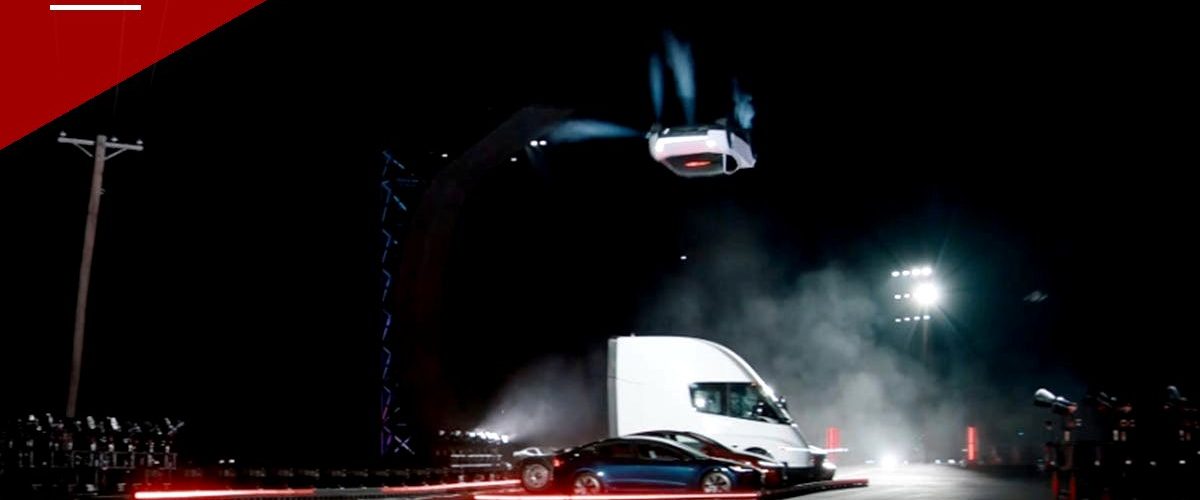
Tesla has unveiled a demonstration of its forthcoming Roadster, slated for 2028 production, showing the vehicle climbing a half-loop ramp, flipping upside down at the top, and appearing to hover briefly in midair on thrusters before settling back to the ground.
The footage has drawn sharply divided reactions online, with some calling it a genuine engineering milestone and others dismissing it as spectacle. But the demonstration has also renewed attention on Elon Musk’s broader business footprint in the United States, including reported discussions with Taiwan Semiconductor Manufacturing Company over a potential collaboration on a “Terafab” semiconductor facility in Texas.
Musk’s record spans early work in online payments, electric vehicle manufacturing, artificial intelligence, and SpaceX’s development of reusable rocket boosters that land back on Earth. Commentators discussing the Roadster footage pointed to that track record as evidence the country benefits from having entrepreneurs like him based in the U.S. One commentator put it simply: “In fact, we need 16,000 more Elon Musks.”
Warren’s Comments Draw Contrast
The demonstration also became a flashpoint in a separate, unrelated political exchange this week. Senator Elizabeth Warren posted criticism of a possible merger between companies that make mayonnaise and hot sauce products. The post drew wide ridicule online.
Mike Solana, chief marketing officer of Founders Fund and editor-in-chief of Pirate Wires, posted a contrast on X, the platform Musk owns, writing: “liz warren: we’re gonna stop the mayonnaise company from buying a hot sauce company,” followed by “elon musk:” alongside the video of the Roadster’s hovering feat.
The juxtaposition was offered as an illustration of two different approaches in American public life: regulatory scrutiny of ordinary corporate mergers on one side, and large-scale technological risk-taking on the other.
A Case for Fewer Barriers
Supporters of Musk’s approach argue the country’s economic strength depends on attracting and retaining entrepreneurs willing to take on ambitious, failure-prone projects, from spice and condiment acquisitions to semiconductor fabs to aerospace. They argue that incentive structures, not penalties or additional roadblocks, are what allow such projects to succeed.
The reported discussions around the Terafab facility in Texas are one example cited of the kind of large-scale domestic manufacturing investment proponents say depends on a regulatory environment that rewards rather than obstructs risk-taking.



Add comment