
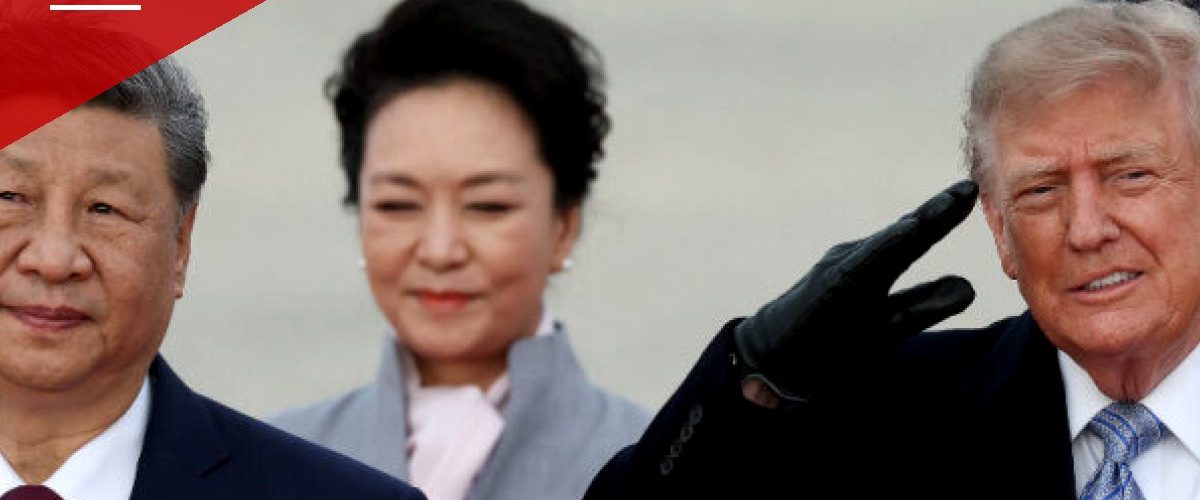
As the Trump administration prepares for another meeting between President Donald Trump and Chinese leader Xi Jinping, national security analysts point to a string of military, economic, technological, and diplomatic moves they say have shifted leverage toward Washington in its ongoing competition with Beijing.
Michael Lucci, founder and CEO of State Armor, told Breitbart News that while public attention has centered on Trump’s rhetoric toward Xi, the administration has been engaged in what he called “unprecedented geopolitical maneuvering behind the scenes.” He pointed to the deal Trump signed with Denmark and Greenland, which he said secures a “permanent, dominant position in the Arctic while also cordoning off Chinese influence in the Western Hemisphere.”
Lucci also cited NATO defense-spending increases, U.S. arms support for Ukraine and Taiwan, moves to cut off China’s access to cheap Venezuelan and Iranian oil, and efforts to reduce American reliance on Chinese supply chains, including the Pax Silica initiative. “Thanks to President Trump’s relentless actions, America has a much stronger negotiating position today than it did during the 4-year collapse of American deterrence under President Biden,” he said.
Mike Martin, a former senior national security official in the first Trump administration, said confronting China has become central to the administration’s economic and security agenda. “That approach must continue as competition with China increasingly extends into artificial intelligence and other technologies that will shape America’s economic and national security for decades,” Martin said, adding that the U.S. “cannot afford to trade one strategic dependency for another” and should keep its AI sector open and competitive while resisting Chinese Communist Party efforts to gain leverage over American industry.
Military and Arctic Positioning
NATO members agreed in 2025 to raise defense spending to five percent of GDP by 2035 — at least 3.5 percent for direct military needs and up to another 1.5 percent for related security costs — following years of pressure from Trump on European allies to spend more on their own defense.
The agreement Trump signed Tuesday with Denmark and Greenland lets Washington modernize and expand operations at Pituffik Space Base and establish new defense areas at Narsarsuaq and Mestersvig, while barring non-NATO countries from setting up military installations or a persistent presence without the signatories’ consent. Trump also announced plans for two major new military bases.
Cutting Off China’s Energy and Mineral Leverage
In January, Trump imposed a 25-percent tariff on countries doing business with Iran — a measure expected to hit China hardest given its purchases of sanctioned Iranian oil. That came after China lost full access to Venezuelan oil following the arrest of former Venezuelan leader Nicolás Maduro. Chinese Foreign Ministry spokeswoman Mao Ning said Beijing would “firmly protect its legitimate and lawful rights and interests.”
The administration has also worked to break China’s grip on critical minerals. In October 2025, Trump signed a deal with Australian Prime Minister Anthony Albanese committing more than $1 billion each from the two countries toward mining and refining projects, with the U.S. Export-Import Bank offering up to $5 billion in financing. China currently produces roughly 70 percent of the world’s rare-earth minerals and controls about 90 percent of global refining capacity.
In the Democratic Republic of the Congo, American company Virtus Minerals acquired the Etoile and Mutoshi cobalt and copper mines with U.S. government backing — mines that could eventually produce a combined 75,000 tonnes of copper and 20,000 tonnes of cobalt annually. China currently controls more than 70 percent of Congolese cobalt and copper output. A State Department spokesperson called the Virtus deal an “initial flagship U.S. investment in the DRC.”
Trump launched Project Vault in February, making $12 billion available to protect and develop American mineral companies, and the U.S. has pledged $5 billion toward the Lobito Corridor connecting the DRC to Angola’s port of Lobito.
Securing AI and Tech Supply Chains
The administration recently tightened scrutiny of Chinese-made equipment in America’s power grid as electricity demand from artificial intelligence rises. Trump signed an executive order declaring a national emergency over foreign-made equipment in the bulk-power system, giving the Energy Department authority to restrict transactions involving equipment used in the grid and data centers.
Chinese firms supply a significant share of transformers, switchgear, batteries, and optical transceivers used in data centers. Johns Hopkins University’s Yury Dvorkin said China’s share of certain transformer and switchgear categories approaches 30 percent, and it supplies more than 40 percent of U.S. battery imports; Chinese firms also account for roughly two-thirds of global optical transceiver supply.
On semiconductors, Substrate founder and CEO James Proud told Breitbart News in August that the administration had done a “phenomenal job,” saying, “We are now building more fabs than we built in I think 20 years in the United States.” The Commerce Department announced in June 2025 that it had secured a $200 billion investment from Micron Technology to expand domestic memory-chip production.
The FCC has also added foreign-made advanced robotics and connected power inverters to its Covered List after determining they posed unacceptable security risks. Chinese-made humanoid robots account for an estimated 85 percent of the global market. FCC Chairman Brendan Carr said the move was meant to “secure America’s critical supply chains.”
Contesting Strategic Ports
The administration reached agreements with Panama giving American military and auxiliary vessels priority passage through the Panama Canal and expanding the U.S. presence there. Defense Secretary Pete Hegseth said “Chinese influence cannot control our own backyard,” and announced Fort Sherman would reopen jointly with Panama.
The U.S. has also backed development of Greece’s Elefsina shipyard as an alternative to the Chinese-controlled port of Piraeus. The U.S. International Development Finance Corporation later committed $125 million to modernize Elefsina after Chinese state-owned COSCO had expressed interest in buying it. U.S. Ambassador to Greece Kimberly Guilfoyle said she would push American investment and infrastructure in Greece and push back against Chinese interests where necessary. Greek official Adonis Georgiadis said a competing route through Elefsina would mean China’s Belt and Road Initiative “faces big damage.”
The Western Hemisphere
Through the Shield of the Americas initiative, Trump hosted leaders from Argentina, Paraguay, Bolivia, Chile, Panama, El Salvador, Ecuador, and other countries at a summit publicly framed around combating drug cartels and regional security. Secretary of State Marco Rubio said the summit also carried a strong economic focus, with representation from trade, commerce, energy, and treasury officials. Special envoy Kristi Noem said participating countries would work together to defend their “sovereignty,” “security,” and “economic prosperity.”
Chinese officials responded by warning that Beijing’s cooperation with Latin American and Caribbean countries “should not be disrupted or affected by any third party,” and China’s Global Times criticized the initiative.
Trade and Other Fronts
U.S. Trade Representative Jamieson Greer wrote in the administration’s 2026 Trade Policy Agenda that the goods trade deficit with China fell 32 percent year over year in 2025, and that “for the first time since 2000, China is no longer the trading partner with which the United States has its largest trade deficit.”
In July, Trump announced his administration would work with states to address election-system vulnerabilities after the White House released declassified intelligence indicating voter rolls in at least 18 states had been compromised by China, affecting more than 200 million voter records.
Trump also raised the case of Pastor Ezra Jin Mingri, founder of Beijing Zion Church, directly with Xi during a May visit to China. Jin was released two months later and reunited with his family in the United States. His family thanked the Trump administration “for their tremendous leadership,” though Human Rights Watch’s Maya Wang noted at least eight other Zion Church members remained detained.
Add comment