
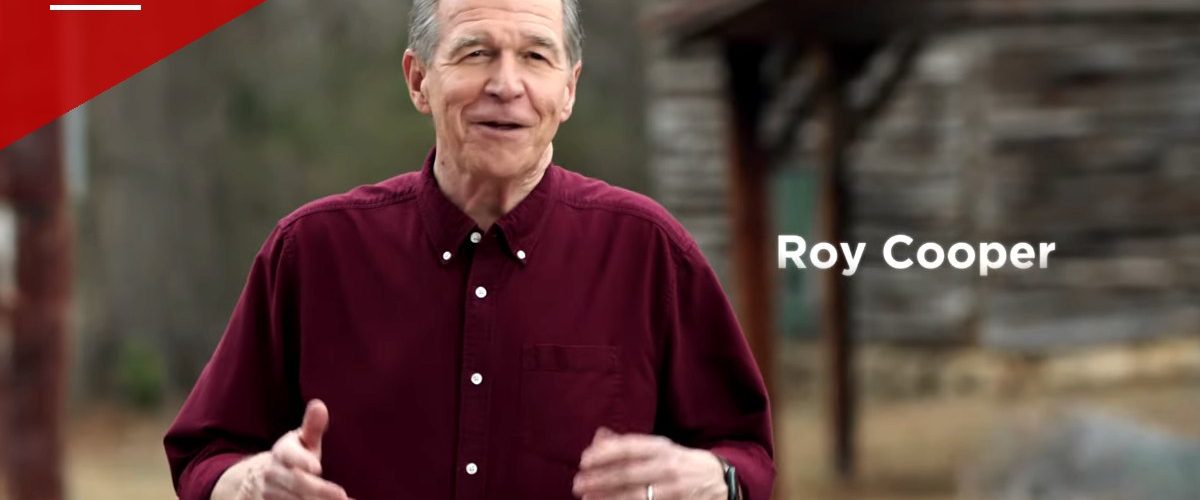
Former North Carolina Governor Roy Cooper launched his U.S. Senate campaign at a Raleigh brewery, standing behind a podium sign reading “Make Stuff Cost Less,” flanked by a tobacco farmer from Wilson County who spoke on his behalf.
Cooper’s opening campaign ad leans heavily on biography rather than policy specifics. It opens with images of his father and mother, described as “a teacher” and a “small-town lawyer and farmer,” and moves through scenes of church attendance and high school football. The framing echoes the “faith, family, and community” language Cooper used throughout his time as governor. Cooper has said he is running “to do something,” not “to be something.”
Political observers have noted the strategy is working, at least in terms of image. Roll Call has written that Cooper has “burnished an image as a mainstream Southern Democrat,” while The Bulwark has described his public style as a “‘folksy’ demeanor.” One Democratic strategist put it directly: Cooper built “a North Carolina Democratic brand, and that brand is not a national Democratic brand.”
A Different Record in Raleigh
Cooper’s actual record as governor complicates the moderate framing. In 2023, he vetoed legislation intended to restrict sex-transition medications and surgeries for minors. Separately, when the ACLU sued over prison conditions during the COVID-19 pandemic, his administration responded by releasing thousands of inmates. A New York Post investigation later found that eighteen of those released inmates were subsequently charged with murder.
Voters weighing Cooper’s Senate bid are left to reconcile a campaign built on small-town, faith-and-family imagery with a governing record that moved further left on criminal justice and gender-related policy.
A Familiar Pattern Among Democratic Candidates
Cooper’s positioning mirrors a strategy Democrats have used before. Joe Biden ran for president in 2020 as the folksy, moderate alternative to Elizabeth Warren and Bernie Sanders, only to govern quite differently once in office. The Biden administration ended the Remain in Mexico policy, paused construction of the border wall, and created a parole pipeline that admitted more than 530,000 migrants from four countries. Border apprehensions during his administration hit a record of nearly 370,000 in a single month, and he raised the annual refugee admissions cap to 125,000, the highest level in nearly three decades.
The Biden Education Department also attempted to rewrite Title IX to include “gender identity” under federal sex-discrimination law, an effort that was later blocked by the courts. The Equal Employment Opportunity Commission under Biden issued guidance requiring that men have access to women’s restrooms and that employers use workers’ “preferred” pronouns.
Other Democratic Senate candidates running this cycle show similar contrasts between campaign image and public record. In Texas, candidate James Talarico, a pastor, has said God is “nonbinary,” describing the divine as “both masculine and feminine, and everything in between,” and has said Jesus helps him “reckon with my own whiteness.” In Michigan, Abdul El-Sayed presents himself as a technocratic public-health candidate while backing Medicare for All, calling ICE “corrupted at its soul,” and describing Israel’s conduct in Gaza as “genocide.” In Maine, progressive activists had rallied behind Graham Platner, who has a tattoo resembling Nazi iconography, until a sexual assault allegation forced him out of the race; they have since regrouped around Troy Jackson, who twice led Bernie Sanders’ presidential campaigns in the state.
Whether Cooper’s brand of Southern moderation would hold up in a Senate controlled by his party’s national leadership remains an open question for North Carolina voters weighing his record against his ads.



Add comment